
Parental - Infant Reciprocity
by © 2001 ~ June Kaminski, MSN PhD(c)
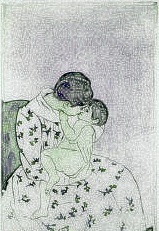 This work is from a booklet produced for new parents during clinical course work at a local obstetrical hospital during my MSN studies at the University of British Columbia. The booklet
was originally written in 1990 and updated for this article.
This work is from a booklet produced for new parents during clinical course work at a local obstetrical hospital during my MSN studies at the University of British Columbia. The booklet
was originally written in 1990 and updated for this article.
Introduction
Each parent and baby are unique individuals, each with their own way of interacting with their world. They must both learn how to "tune in" to one another.
What is Reciprocity?
Reciprocity is a process of communication between a baby and a parent. The baby sends out signals about his or her needs, using facial and vocal expressions, and waits for a response. The parent reads and responds to the baby's signal's, which serves as a return signal for the baby to read. Reciprocity is a process of mutual adaptation between a parent and their baby. As mother/father and the baby come to know each other, they both learn to read the other's signals. Each parent and baby are unique individuals, each with their own way of interacting with their world. They must both learn how to "tune in" to one another. Reciprocity develops as parent and baby each learn to maintain satisfying exchanges for both parties.
Why is Reciprocity Important?
Reciprocal interactions with a parent help a baby learn to be sociable, to
see themself as others see them, to learn how to effectively communicate, and
how to think, and how to cope in their world. A sound reciprocal relationship
also helps the mother and father to gain self-confidence as a parent. It helps
them to learn to stimulate the baby's senses and meet their needs, and how to
effectively talk to him or her. This helps the parent to spur their baby's
intellectual, social, emotional, language, and memory development.
When a parent immediately responds to his or her signals of need, the child
learns to expect the world to be predictable and responsive. The baby learns
that he or she can have some control in their world. This encourages babies to
explore new situations and people, and helps them to grow and experience
mastery.
How does Reciprocity Work?
THE BABY
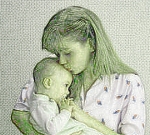 The
newborn is responsive to speech sounds and quickly learns to read her or his
parent's tone and tempo of speech. He or she learns to know the parents through
their touch, gestures, and facial expressions. The baby begins by looking and
listening to the parents. He or she can pick out features of the parent's face
and voice (pitch, intonation,affective tone, expression). The baby will move his
or her body in time to the rhythm and cadence of the parent's voice. Babies are
very quick to recognize and interpret verbal inflections and non-verbal
language. They learn to associate a soft, high - pitched, lyrical voice and a
warm expressive, smiling face with comfort and pleasure.
The
newborn is responsive to speech sounds and quickly learns to read her or his
parent's tone and tempo of speech. He or she learns to know the parents through
their touch, gestures, and facial expressions. The baby begins by looking and
listening to the parents. He or she can pick out features of the parent's face
and voice (pitch, intonation,affective tone, expression). The baby will move his
or her body in time to the rhythm and cadence of the parent's voice. Babies are
very quick to recognize and interpret verbal inflections and non-verbal
language. They learn to associate a soft, high - pitched, lyrical voice and a
warm expressive, smiling face with comfort and pleasure.
The baby's eyes are attracted to the human face, especially the eyes. Babies'
ears are "fine - tuned" to hear the human voice. They respond with their body
and maintain eye to eye contact by gazing into his parent's eyes. The newborn
can do this best if they are held 7 to 12 inches away from the parent's face, in
an enface position (held upright, with head supported, facing the parent face to
face).
Babies are able to react reciprocally to patterns of sound and movement. They can learn to imitate their parent's vocal and facial expressions, and notice when their parent imitates them. They learn to "take turns" in conversation - like exchanges with their parents. When either the baby or the parent sends a signal, the other responds to the signal. The infant learns to socially smile in response to high - pitched human voice tones, and later (as early as 3 weeks) to the animated human face.
THE PARENT
The art of "mothering" is a learned skill. Mothering means a sensitive,loving, and individualistic approach to baby by a very tender mother or father. It provides prompt and predictable responses to the baby's needs for attention, nourishment, and comfort. The parent's behaviour as a teacher affects their baby's future growth as a learner. The regulation of reciprocal interchanges is a skill to be learned. The parent's task is not to create behaviour out of nothing. Rather, he or she needs to learn to synchronize themself with their baby's already organized behaviour. The parent needs to understand the rhythm of the baby's actions and to learn to predict their immediate needs.
The parent can have fun using the natural instruments of their voice, face, smile, head,and body to engage the baby in a "dance - like" exchange. A reciprocal exchange is cyclic. The conversation should alternate between parent and baby in a pattern.
A parent can gain a sense of competence by observing their baby's state of contentment when he or she responds quickly to the baby's signals (picks him or her up when they cry, returns the baby's gaze, imitates the baby's gurgles, and so on). Attentive parents have responsive babies. Mothers and fathers need to speak, sing, and laugh with their babies while encouraging the baby to respond to them with coos, gurgles, smiles, babbles and laughter.
Being a Biological Mirror
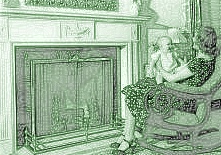 Imitating the baby's facial expressions, vocal sounds, and body movements helps
the baby become aware of him or herself, and feel responded to and acknowledged.
This also helps the baby to learn to imitate the parent's responses and
expressions.
Imitating the baby's facial expressions, vocal sounds, and body movements helps
the baby become aware of him or herself, and feel responded to and acknowledged.
This also helps the baby to learn to imitate the parent's responses and
expressions.
Engaging in "Dialogue":
By imitating and talking with the baby, the parent allows their mutual
exchanges to become a synchronized play of signals. This helps the baby to
develop reciprocal skills. By continually being exposed to his parent's varied
visual and verbal input, the baby learns to direct his or her attention to the
outside world. When parents immediately respond to the baby's signals, they help
the baby learn how to respond to others and to develop trust in the world. The
way that the parent sequences and times their responses and actions helps the
baby understand human communication and to express emotions healthily.
The baby's attention is best engaged with a non - expressive face. Once he or
she is looking at the parent, they can hold the baby's attention by changing the
rate of facial and vocal expressions. Babies love wide - open eyes, animated
eyebrows and mouth movements, smiles and laughter. These movements encourage the
baby's attention by changing the rate of facial and vocal expressions.
 The
sensitive parent will allow their baby to show his or her most skilled social
behaviors by holding him or her in an upright position, and maintaining eye to
eye contact while they "talk" to one another. They come to realize that babies
need "time-outs" during these exchanges, and will indicate this to the parent by
averting his or her gaze for a few moments. Most babies alternate between
periods of engagement and periods of "time-out" 4 to 5 times per minute.
The
sensitive parent will allow their baby to show his or her most skilled social
behaviors by holding him or her in an upright position, and maintaining eye to
eye contact while they "talk" to one another. They come to realize that babies
need "time-outs" during these exchanges, and will indicate this to the parent by
averting his or her gaze for a few moments. Most babies alternate between
periods of engagement and periods of "time-out" 4 to 5 times per minute.
The attuned parent learns that by responding to the baby's crying or distress
signals right away, that in the future, the baby will cry less. When the parent
responds to distress signals by comforting the baby, the baby comes to trust
that his or her needs will be consistently met. This can be done by the parent
showing their face to the baby, by picking the baby up, swaddling, or rocking
him or her. Parents come to realize that it is not possible to spoil a young
baby by responding consistently to his or her cries for care or comfort.
Each baby is different in the way that they respond, in the way they are
soothed; in their rhythm of sleeping, eating, communicating, and in their
ability to adapt to the world. Parents need to learn to know their own baby's
ways of responding. The parent's sensitivity and attunement to the baby, helps
the infant to better grow as a caring, healthy, and happy person.
© June Kaminski Published: 2001.
Portfolio Menu
Nursing Informatics Flickr


